
[No AI was used in composing this blog post.]
I’ve been trying to get back to the blog recently. But every time I plan to write a blog post, something happens that requires my attention and adds to the list of items I should be writing about.
I’ve decided that the best I can do, for now, is to summarize some of the key stories that have been on my radar. The overarching news, aside from the 2026 physics Nobel Prize, is what you’ve heard: artificial intelligence (AI) is transforming mathematics and high-energy theoretical physics, no question. That said, what is reported in the media about this is usually wrong in key details, and almost always wildly overstates what’s been accomplished. Nevertheless, the advances in AI models in the last couple of months are historic and transformative, and there is every reason to expect this to accelerate. For people like me, 2027 will surely be very different from autumn 2026, which in turn barely resembles spring 2026.
Because I’m covering so many topics so briefly, the chance of an error is pretty high; please let me know if you spot inaccuracies. Normally I try to be super-careful, but today I’m prioritizing conveying the sense of things rather than getting every detail right. Moreover, a lot of what follows is half-baked opinion; things are happening way too fast for me to be sure that my thinking is clear and correct, so you should interpret this post in that context.
A first point: as many experts have noted recently, AI unchecked is extremely dangerous. This is especially true of artificial general intelligence (AGI) machines— machines that are capable of learning to do anything and everything we can, and can do it faster, better and tirelessly. AGI machines are, in my view, a path to slavery and death for a large fraction of humans — possibly a near-death sentence for our species. I personally believe that AGI development and usage should be banned, NOW. (A draft of a document laying out my argument is here; comments are welcome.)
However, specialized machines that are very good at a number of things, but very bad at others, are somewhat less dangerous. This includes tools that can do math and physics better than any human; they will be very useful, but dangerous if they can also command a robot army or shut down a banking system.
As for the new AI-led or AI-assisted results in math and science, they are coming thick and fast. Already in August and September, Anthropic claimed its models had made progress on the famous Riemann hypothesis, and had solved a particular 9-loop quantum field theory calculation. The latter is a rather esoteric achievement, even for most high-energy physicists, much less for the layperson. In a sense it’s a math problem, and not one that, by itself, leads to any fundamental new insights in physics that I’m aware of. It was also over-hyped in the media. But still, it is a significant accomplishment that surprised the experts.
The real flood began in early October. First, OpenAI claimed to have solved a key question concerning the notoriously difficult Navier-Stokes equation for how fluids flow. Initial wild rumors suggested that they had actualy solved this equation; had this been true, it would have meant that they understood turbulence, one of the oldest and greatest problems in all of science. The reality was far less; they had proven an important fact about the equation’s solutions. In a sense, this is one of the “Millenium Prize” problems (whose solution is worth a measly $1 million), but this is somewhat disputed, because the problem was solved under a certain assumption that some would say should not have been made. There are other controversies, involving whether certain mathematicians’ work was improperly used. Moreover, the work involves finding a counterexample, which is much easier than a proof of the absence of counterexamples. On top of that, the proof (even the version intended for humans) is excessively complicated, and challenging for a human to interpret. By itself, impressive for sure, but not nearly as much as the hype.
But then on October 6th, OpenAI dumped hundreds of papers on us, with results in mathematics and theoretical physics. Many of the results were interesting and a few seem important, including notably a further significant advance on the Riemann hypothesis. Unfortunately, most of the papers are long, technical and extremely difficult to read; they seem pretty useless. They may be correct, but there simply aren’t enough human experts in the world to verify them all and to translate them into shorter efficient summaries that can aid future human thinkers. Worse, imagine now that this is just the start: that hundreds of such papers, and soon tens of thousands, will be dropped on us every month. This will just bring the mathematically-oriented sciences to a halt, to no one’s real benefit. There has to be a better way to approach this.
Then on the 26th, OpenAI claimed three big new results in math, computer science and physics; the computer science result was also claimed, more or less simultaneously, by Anthropic. The physics result was widely and mistakenly reported as a solution of the key mystery of the theory of the strong nuclear force: why, in a theory that purportedly describes massless gluons, does the theory in the end exhibit no massless particles, with the gluons all confined into massive clumps (called “glueballs”)? (In jargon, this is called “generating a mass gap.”) Had OpenAI done that, it would have solved one of the central “Millenium Prize” problems. But despite the media hype, the reality was much less glamorous; OpenAI merely claims to have proved that the field theory that describes the strong nuclear force makes mathematical sense. That is a long way from proving that the strong nuclear force confines gluons (and by extension, quarks too, in a limited sense.) A proof of confinement would be worth a “WOW!”, and worth $1 million. A proof of existence, however, while definitely important, won’t affects most experts’ research; for them, it’s worth a raised eyebrow, and a “we knew that from experiment, but it’s nice to have a math proof”. And yet again, the proof is hundreds of pages long and apparently very hard for humans to interpret. It will take experts weeks or months to get through it and reduce it to a form that anyone else can handle — and only then are we likely to understand if the proof is actually useful for physics, rather than merely a technical feat that only a machine could love. There’s a pattern here…
But meanwhile, physicists are using these AI tools to try to solve problems that are of greater interest and perhaps greater importance than those that Anthropic and OpenAI have announced. So far these have tended to be pretty esoteric from the view of the general public, but one early October claim (by Nathanial Craig, who is a visitor at OpenAI and a professor at UC Santa Barbara) is that a technique may have been found, using OpenAI’s AI model “Astra”, to define quantum field theories like the Standard Model on a “lattice” — a grid in space and time. (This is notable because Craig, while an leading expert in particle physics, is not known as an expert in this subfield of “lattice quantum field theory”.) This technique might lead to a method for simulating these theories on computers, which has not previously been possible. In such theories, referred to as “chiral”, the masses of particles like the electron and the quarks can only become non-zero in the presence of a Higgs field (here’s why); and this makes numerical simulation extremely difficult, because (speaking very crudely here) massless electrons and quarks are normally very hard for computers to handle. If the paper is correct and leads to a practical simulation technique, it could prove very valuable for future developments in particle physics and elsewhere. Unfortunately the paper is over 100 pages, and despite Craig’s efforts to convert the work of ChatGPT-Astra into a human-readable form, it will be some time before the field digests it; I myself have no time to do so. And this is one of many papers that are appearing faster than I can even read the titles and descriptions, much less convey their essence to you.
In a totally different vein, my Harvard colleague Matt Schwartz used Anthropic’s AI models (“Claude”) to solve whole new classes of mathematical integrals that are important for particle physics. Then he used AI to look for problems in other areas of science (and beyond) where these same integrals also appear. Collaborating with experts in those areas, he has now used his tools in dozens of significant projects ranging across many disciplines. It’s quite a tour de force, and would have been impossible before mid-2026. You can read more about that here.
This whole process is generating a lot of political backlash. Through personal connections, some scientists are getting access to the AI tools and the AI companies in ways that create haves and have-nots, undoing decades of efforts at making physics a more quasi-democratic meritocracy. Increasingly it seems that producing the best science has less and less to do with talent, and more to do with wealth and power and one’s political standing and “who you know”. (A disturbingly secretive invite-only meeting at the KITP-UCSB last week did not help matters.) It’s the old boys club all over again, with billionaires running the show. I hope that this trend will not continue, as there will be a lot of bad blood if it does.
So high-energy theoretical physics is in the midst of a vast transformation. One way to say it: there will never be another Newton or Einstein, because even the smartest scientist will work with AI from now on, and AI will do most of the work, and probably will be producing some or most of the ideas. It’s not even clear there will be anything for human experts to do, in the long run, other than interpreting AI results for human consumption. But for real progress, AI models need to get a lot better at writing papers and simplifying their proofs, derivations and arguments. Any proof or calculation is worth a lot more when it is both correct and efficient, and scientists have historically gotten a lot of credit for simplifying past results that were nearly uninterpretable. This is partly why Julius Schwinger, the genius who could do Herculean calculations using elaborate mathematical methods, is not as widely known today as Richard Feynman, who did some of the same calculations using methods that were easy for everyone to understand and implement.
For all these developments in mathematical/theoretical science, we should remember that at heart, physics is an experimental science. AI can’t “solve the universe” by just thinking; it has to make predictions, and those predictions have to be tested in the physical world. Even if AI invents seven new theories of quantum gravity, or other ways of explaining the cosmos, it will not tell us which of these theories is relevant for our own universe. Without experiment, we can only know all possible worlds; we cannot know which one is our own. So experimental physicists certainly have not been replaced… not yet. To replace them will require great advances in robotics.
Finallly — old school — a particle theorist won a Nobel Prize for inventing a new way to look for neutrinos, and then leading the experiment that first carried it out. As far back as 1960, it was suggested by Moisey Markov (who died long ago and could not be considered for this year’s Nobel prize) that neutrinos could be searched for in a deep lake or ocean; on the rare occassions that a neutrino hits the nucleus of an atom in the water, the super-fast fragments from the collision emit Cerenkov light, which though faint can be observed in the abyssal darkness. However, there are other things that emit light in the ocean, and there are complications such as waves and storms (and salt, in oceans) that make building a stable detector challenging. In 1988 Francis Halzen had the clever idea of using ice instead of water — of melting deep holes into an ice sheet and putting light detectors into them. Ice has no waves and no critters emitting light; detectors in ice stay where you put them. The ice that lies below the south pole is both deep and pure, perfect for this effort. Unusually for a theorist of the time, Halzen chose to lead the experimental collaboration that built the first ice-based detectors, initially AMANDA and then the much larger IceCube. I wrote an article explaining IceCube here; it’s still current. So successful was this idea that it led to the birth of high-energy neutrino astronomy. Only very recently are deep water detectors catching up with IceCube, potentially making important discoveries of their own. Halzen’s Nobel-Prize winning idea (which, I’m told, occurred to him after a winter’s lunch in sight of the frozen lake that borders the University of Wisconsin, where he has spent his career) appears in a very short paper (with John Learned). It contains no math — much of it can be read by a layperson — and ends with a quaint diagram, reproduced below. The picture says it all. The prize isn’t merely for this paper though; it is also for shepherding the idea all the way to fruition, and ensuring that real discoveries about the universe were made with it.
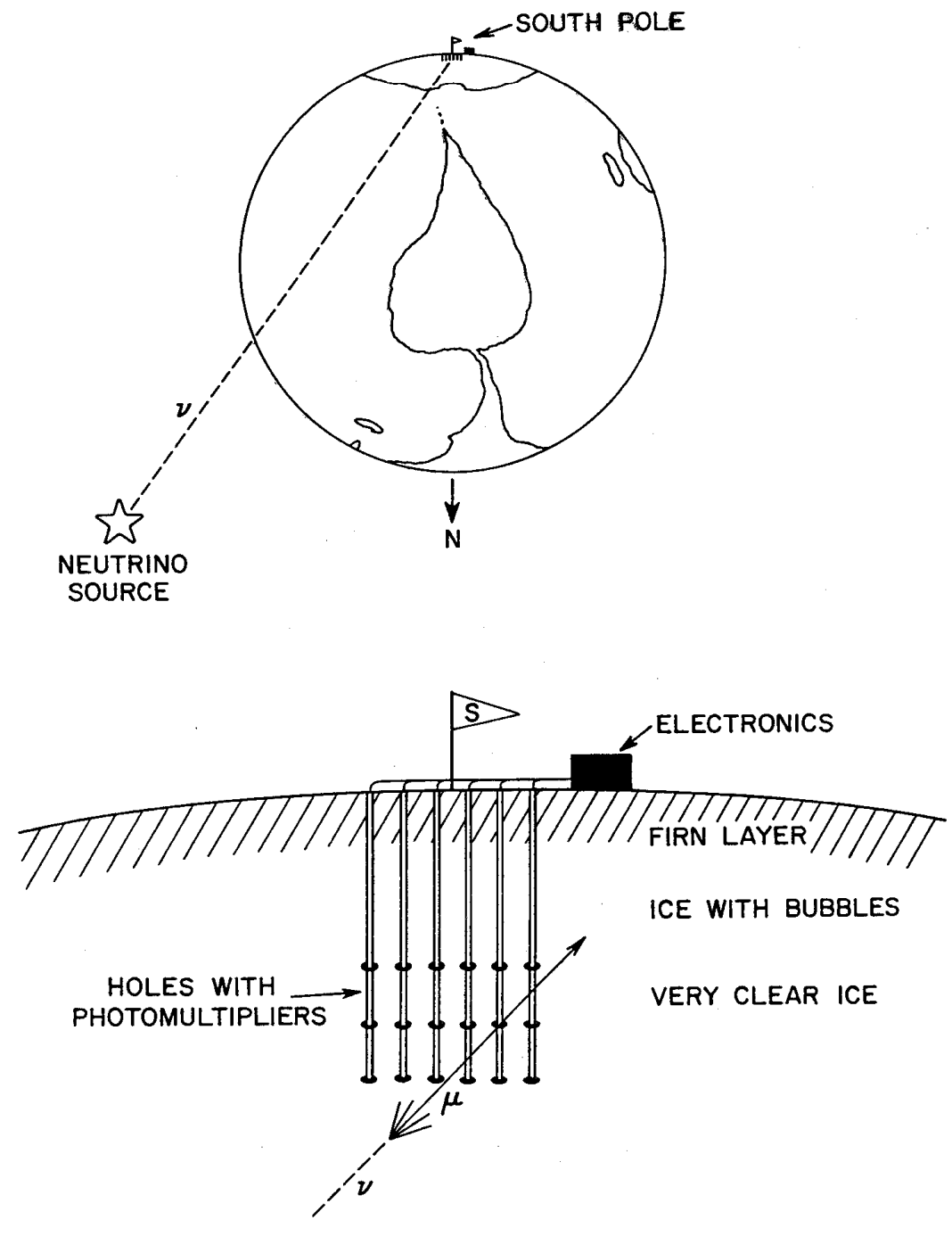
As for me, I’ve been working on black holes with Harvard colleague Mark Riojas, and we’ve discovered some very interesting things (without using AI, I’m pleased to say!) I don’t have time to write about that now, but maybe I’ll get to it later. That’s in addition to some Large Hadron Collider physics, mostly on this and related subjects, and a public outreach workshop at Canada’s Perimeter Institute.
Such is the news for today. If I sound frazzled, it’s because I am. It’s a time of great chaos. I suppose we’ll muddle our way through it somehow.



26 Responses
Any thoughts on Witten’s extension of Craig’s paper? (Including the fact, which updated my posteriors on model capabilities, that he acknowledged AI usage)
There is so much happening in AI and science right now that it’s becoming difficult to separate genuine breakthroughs from media hype Geometry Dash Lite. I really appreciate the effort to explain what these developments actually mean.
Welcome back and thanks. As you teach everyone here, we’re all teachers and students of one another including you as a world class professional physicist of immense talent.
What I’ve noticed about your posts and replies here is how you treat people fairly; you’re a master of the written word; your punctuation, emphasis of words, the way you express yourself etc is masterly. Would I be correct in my belief that you can touch type at around 100wpm?
If I give my correct email address, will I get notifications to any further replies to this reply to your main post here?
I still think you should have recent replies of everyone to any post on your blog on the blog home page to steer anonymous interested folk to threads that are still active and hence may want to chip in to the interesting discussion there. This would help to reactivate discussions to a possibly very old post of yours that we wouldn’t know about otherwise.
Hi Matt, just a heads-up: videos from the KITP meeting are now posted here: https://online.kitp.ucsb.edu/online/physicsai-m26/. Unfortunately, “discussions” were not recorded (per Nathaniel’s welcome introduction).
On November 13, 2014 NASA reported that its X-ray telescopes found that maybe Milky WY’S Black Hole is a neutrino factory.
On AI: this tool contains more info than ever, demanding more quality control than ever. This issue is , I think, of vital importance.
….of vital importance for science.
Tackling the issue of quality control is Chefsache. Idea fixing is like creating bad money. Bad money drives out good money (Gresham’s law). The basis for good quality control by Academia with regard to the difference between Science and Idea Fixing can be found in Matthew 25: a good shepherd knows the difference between sheep and goats and acts accordingly.
I have no idea about the importance of OpenAI’s QCD proof (#1 not a mathematical physicist, #2 they didn’t even tell us what the proof is yet), but this got a chuckle out of me:
“A proof of existence, however, while definitely important, won’t affects most experts’ research; for them, it’s worth a raised eyebrow, and a “we knew that from experiment, but it’s nice to have a math proof”.”
In my experience, this is the reaction of every experimental or theoretical physicist to many results in mathematical physics. And who can blame them?
In October 2026, OpenAI (supposedly) proves the existence of QCD: “shrug, who cares, we already knew that from experiment”
In 2027, HyperGPT 8 proves mass gap in QCD: “shrug, who cares, we already knew gluons were confined, that’s incredibly obvious both from experiment and from the lattice”
At the same time, HyperClaude proves the *non-existence* of interacting QED (i.e. that QED is 4D is “free” as widely suspected): “shrug, who cares, our QED calculations still match experiment, the Standard Model is just an effective theory anyway”
It’s impossible to evaluate the proof anyway because it hasn’t been released and we don’t even know exactly what they are claiming. But your dismissal just struck me as exactly what you would expect coming form a theoretical physicist 🙂
I take your point — and this is partly a result of rushing out a post with too much in it. The argument I gave is glib, hence your chuckle. This issue deserves a more careful explanation of why (a) proving existence of Yang-Mills theory is the least interesting, intrinsically, though the proof itself could be interesting; (b) proving existence of chiral gauge theories, as Craig and Astra may have done, is more interesting; (c) proving confinement in Yang-Mills theory would be extremely interesting.
The reasons are technical, which is why I didn’t get into them here; but a very short summary is (a) defining Yang-Mills theory (with or without quarks) involves very weak interaction strength, making the math relatively easy, and simulating it is not only practical but widespread in lattice gauge theory (with the addition of quarks being trickier but still widespread) ; (b) defining chiral gauge theories (or supersymmetric gauge theories) may involve very weak interaction strength but has technical problems involving what is known as the regulator (which is necessary for the taming of technical but unphysical infinities in calculations) and simulating such theories is, for this reason, extremely challenging; (c) proving confinement in Yang-Mills theory involves very strong interaction strength and is mathematically very difficult and likely involves new mathematical techniques — while proving it in a lattice simulation is also hard, despite clear numerical evidence of glueballs.
These are statements about the things being proved. A proof itself can always be more (or sometimes less) interesting than what it proves, and that might or might not be the case for Yang-Mills existence. That’s what we’re all waiting to see; is it just a check mark on something we knew was true, or is it revelatory in some way?
Will,
Speaking as an ex-hep experimentalist, if the mass gap leads to a prediction of the mass of the lowest energy glueball it would be very significant.
I don’t entirely agree, Paul. That would be a second step.
The first step is to explain why confinement occurs at all. We know why magnetic flux in superconductors is confined; there’s a simple description of that. We don’t know why chromo-electric flux in a pure-gluon (Yang-Mills theory) is confined. We know lots of theories similar to Yang-Mills in which we believe confinement is plausible because we have proposed simple descriptions of confinement, but almost all rest on a web of conjectures for which proofs do not yet exist. In Yang-Mills itself, we have no proposed simple description. The mathematics for this seems not to be known yet, or, if it does, it seems a fresh idea is needed in order to figure out how to use it.
Going from confinement itself to an direct method for calculating the masses of bound states (glueballs) may be much harder. But also, for the lightest glueballs it’s arguably not necessary, since lattice simulation is perfectly suited to answering that question. Where lattice cannot work, and we would need new mathematics, is in finding the full tower of glueball states (when the number of colors is large, making all the states relatively long-lived.)
Genuine thanks for your responses. When I was in the field, I got the impression that physicists really did not care about these sorts of issues at all (and at the time I was very firmly in that camp).
When I said “In 2027, HyperGPT 8 proves mass gap in QCD: “shrug, who cares, we already knew gluons were confined, that’s incredibly obvious both from experiment and from the lattice””, that would have been me shrugging and also most of the physicists I knew–theorists, experimentalists, and lattice folks.
So your perspective is somewhat a new one to me.
I did work in hadronic physics (ex experimentalist like Paul), and people sort of used the mystery of confinement as a hook for the field, but I don’t recall that anyone put it in the terms that you did (although not necessarily 100% sold on your view–maybe plausibility arguments are enough–maybe sometimes complicated things are just complicated). So I appreciate the response.
And yes, I think we do already know the mass of the lowest energy glueball, to the extent that such a quantity can be defined at all, it’s somewhere around 1.5-2 GeV. The open questions are about mixing with the quark-y scalar states: namely if the f0(1710) is primarily glueball, or if there is more extensive mixing going. These are the questions we studied in my old field. The answers will hopefully come from experiment and from the lattice, although progress reaching unambiguous answers in this field always feels very slow and sometimes non-existent. As far as I know, no one is proposing that an axiomatic approach will help. Hence my imagined shrugs.
I am not an expert in the field (and I know neither are you), but (like everyone else) I have been reading avidly about it and I believe this is wrong:
“In a sense, this is one of the “Millenium Prize” problems (whose solution is worth a measly $1 million), but this is somewhat disputed, because the problem was solved under a certain assumption that some would say should not have been made.”
The Millennium Prize problem is precisely defined and (as far as I know) there is no dispute that what OpenAI claims is a solution to formulation C. So if the proof is correct, the Millenium Prize problem is solved. I don’t believe there’s any dispute about that, unless there’s something recent that I’ve missed.
This SciAm article is pushing the narrative that what they solved is in some sense the least interesting version of the Millenium Prize problem and “not what really people care about”:
https://www.scientificamerican.com/article/did-openai-solve-the-wrong-navier-stokes-problem/
Again, I am not in this field, but to me this seems like a pretty dubious claim; it seems that there were a fair number of mathematicians working on the forced problem, and I don’t see much evidence that there was a pre-existing consensus that the unforced problem was the “real” one.
If a human mathematician had solved the same form of the problem, I doubt there would have been this effort to belittle their accomplishment.
I am not of a strong opinion here, since I don’t really care about the Millenium Prizes per se, and it’s up to the Clay Institute to decide if it is solved or not. Of course mathematicians were working on the forced problem, because it was seen as an easier version of the problem. The question is whether the prize was for the harder version of the problem, even if this was not spelled out word for word by the Clay Institute — and as you say, I am not an expert and have no horse in the race.
I am glad that neutrino physics figure in the news, even more so since “Four countries, including Sweden, initiated the telescope project … which the Swedish Research Council considers to be in the national interest.” https://www.uu.se/en/research/research-infrastructure/international-research-infrastructures-in-which-uppsala-university-participates/icecube-neutrino-observatory
Worth to mention here is that Matt has been among the inspirations for me having started a master in theoretical physics during my retirement. And genAI is the reason why I decided I will stop coding projects, since they are much more productive than I am (but still under my guidance, of course). After a lifetime with coding in everything from modeling physics to understanding massive biological data, it is time to let most of the know how go (to be replaced by new vistas for my curiosity).
So genAI will usher in killings of sorts but like all industrial transformations like electrification it will also birth new areas. At least for now they need guidance and it would be a neat trick to make them develop and evolve to gain a more realistic notion of the world. It is ironic that the light speed limit that more or less guarantees that we do not need to be afraid for SETI (too expensive to use remote resources) has been circumvented with our own creation of alien intelligences here on Earth. Granted, we can communicate with them of sorts, but we can’t yet figure out their ‘biology’.
I read the draft document and while I can see why it relies on emotional anecdotes since they are generally found to be most effective, I can myself not judge those parts. We know that genAI are traitorous but they have obvious other shortcomings too. And that goes for humanity as well, we have evolved – lately by self-domestication – to be the most social and domesticated mammal, but we are also specialists in circumventing social bans. Whether someone will try that ban or not, it is unlikely to hold: how did The Treaty on the Non-Proliferation of Nuclear Weapons (NPT) go!? Or, to take nearlying tack, how did Musk’s takeover preventative of Neuralink which “he perceives as an existential threat to humanity if unchecked” go!? https://en.wikipedia.org/wiki/Neuralink
For better or worse, we have to learn to live with dictators having nuclear bombs and capable genAI that likely was involved in cold start to stealing (initially) 6 bn USD in cryptocurrency within 20 minutes. https://www.bbc.com/news/articles/cwg7xp8kx4v5o
Your points (especially on the draft document) are well taken. Any international treaty has serious limitations. Nevertheless (until Trump) nuclear proliferation had been somewhat under control, and there were some treaties that kept things from getting wildly out of hand, excepting North Korea. The question is how much worse it would have been without nuclear proliferation and nuclear testing treaties. I think we need similar treaties for AGI, even though, as you say, they won’t be ironclad — nothing is.
As for the AI attack on Binance, AI is also defending Binance. The question is why the attack succeeded despite powerful tools being in place to prevent it.
Meanwhile I hope the master’s is going well! Certainly what you will be able to do with a master’s is more than what was possible ten years ago — but the bar will also be higher!
Thank you! Well, the university certainly doesn’t allow students to use genAI freely, it is up to the teacher to set the course rules, so I’m not aware that the bar has moved (yet).
Also, a correction: An alternative and stronger hypothesis on Binance surfaced after I commented, an expert thinks the theft was basically a social engineering attack (like phishing) through a specific employee laptop. Which I guess means we cannot include or exclude genAI help.
What would concern me on genAI is that we are heading in the direction of gene technology. While it would have been instrumental – still can be – to offset greenhouse gas releases and other environmental problems caused by the food industry, the science was restricted while we considered if it would be harmful. Precautions can cause harm, so should be considered carefully. To me, and I would guess others, see the Neuralink-to-xAI owner agenda change, the conclusion does not seem inescapable by fiat but open for research.
As context, in 2004 the Nobel Prize organization released an article that reviewed the 1975 Asilomar Conference on Recombinant DNA suggestions. As I understand it from their and Wikipedia’s article, to take own control of the rule setting they introduced a matched-risk framework, essentially based on 1. “Containment should be made an essential consideration in the experimental design.” 2. “The effectiveness of the containment should match the estimated risk as closely as possible.” The review concludes:
“The Asilomar decisions emerged from a consensus of opposing views. Although the recommendations were clearly “inconvenient”, the participants had a stake in having the science move forward and not in leaving the rules for conducting the research to be set by others. By contrast, there is little prospect for consensus in our society on the ethical issues concerning fetal tissue and embryonic stem cell research, genetic testing, somatic and germ-line gene therapy, and engineered plant and animal species and hence little incentive to seek a compromise. Compromise in those instances may only be achievable by political means, where majority rule prevails.”
I think this will make an already precarious career ladder for hep-th far worse. I suspect that this will discourage many of the best students from a career in Physics and the long-term impact of AI on theoretical physics as a result will be negative. On a brighter note your paper looks really interesting!
What’s really hard right now for students and postdocs (and even young faculty) is how rapidly and unpredictably things are changinhg, literally on the two to three-month time scale. We are going to have to reinvent what it means to do math and physics, and we can’t do it yet because we don’t have any idea what the steady-state will be. Right now, all we can do is make it up as we go along. But if humanity survives, we will adapt. There will always be young people who want to deeply understand the universe, even if that means reading the AI tomes deeply, and we will pay some of them to do it so that humans continue to have this deep knowledge (rather than just the answers to specific questions, which is not the same thing.) It may be somewhat closer to being priests of esoteric knowledge than to being explorers and innovators; but it’s too early to say if that’s right, or what it would mean for the community.
Perhaps people will switch to experiment (not CERN where AI will replace much of the algorithm-type PhD)? Explorer sounds more fun than priest 🙂
Explorer is more fun than priest, but knowledge has its joys; and even among current professionals, most people learn the subject thoroughly but never actually make a major discovery, so they are already mostly priests, teaching the subject to the next generation.
Shouldn’t AIs be very good at translating long, arcane AI-generated proofs into concise, human-comprehensible proofs? After all, that step (presumably?) involves nothing new, and is what LLMs are trained to do. What happens if you ask an AI something like: “Claude, explain this proof to me as though I were a dumb human”?
Don’t forget that while genAI are trained on historical data, they are statistical networks without much insight. (Which is why they still hallucinates.) However, there are signs that they do develop forms of internal insights and they certainly can develop collaborative cultures. (Which, spurred by Matt’s article, I want to point out are prone to historical human problematic traits such as cheating.)
I have to say, it is remarkable how much insight the models appear to be capable of at this point, if insight sometimes means “the ability to recognize hidden patterns based on past knowledge.” The knowledge base is vast, and the pattern-recognition capabilities are very good. I would not underestimate them.
It’s not yet clear why they are not good at this, but of course, a lot of it is in how they are trained. I expect this will improve soon, as it is clearly a key sticking point.
Matt, great to hear from your blog again! Wonderful post (and as we’ve discussed, I wholeheartedly agree with it), but just a couple of comments: the OpenAI Navier-Stokes claim dated from early September, not early October. And it’s Julian Schwinger (not Julius).
Thanks for the corrections! Not sure what brain-wire misfired to turn Julian into Julius. The timeline is all so insane and scattered that I have to look everything up to remember what happened when, and somehow I got wrong information (probably from an AI timeline). I should have known to triple-check, since it didn’t sound right to me at the time…