For forty years, the Canadian Broadcast Company (CBC) has had a famous science radio show called “Quirks and Quarks“; it is currently hosted by science journalist Bob McDonald. I’m pleased to tell you that I was invited onto that show this past week. In my conversation with McDonald, I explained how the Higgs field actually works, avoiding the “molasses”/”snow”/”crowd” analogies that don’t stand up to scrutiny.
(This all happened while I was spending a few days in Ontario. I was meeting all sorts of wonderful people at the Perimeter Institute’s 2024 science communicators conference SciComm Collider 2, organized by Katie Mack. More on that at a later time.)
If you’d like to hear the Quirks and Quarks conversation, or one of the other detailed podcast conversations I’ve had about my book, you can find them here:
From the structure of the Standard Model of particle physics, one might wonder if the electron, muon and tau, so similar except for their masses, might really be the same object seen in three different guises. Last week, starting with a post for general readers, and then looking at the situation in more detail (Part 1 of this two-part series), I showed one way in which this idea fails to agree with experiment. Today I’ll give you another point of failure, focused on a property of particles known as “spin”.
Spin: The Idea In Brief
What is “spin” in physics? It’s related to the word “spin” in English, but with some adjustment. I’ll write a longer article about spin elsewhere, but here’s a brief introduction.
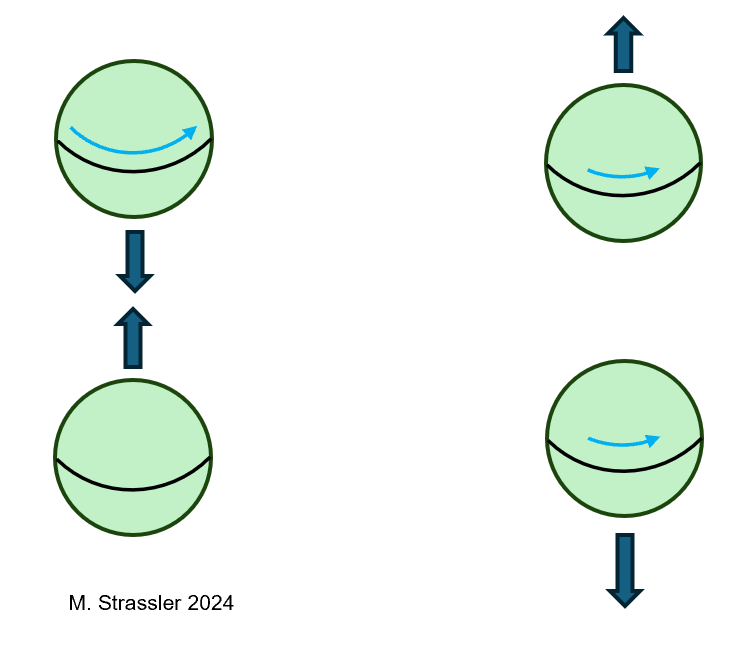
The Earth “spins”, both in the English sense and in the physics sense: it rotates. The same is true of a tennis ball. The rotation can be changed when the ball interacts with a tennis racket or with the ground. It can also be changed when it interacts with another tennis ball. In fact, if two balls strike each other, some of the spin of one ball can be transferred to the other, as in Fig. 1.
Figure 1: (Left) Two balls, the upper one spinning, approach and collide; (Right) The balls recoil from the collision, with some of the spin of the upper ball now transferred to the lower ball.
Elementary “particles” can have spin too, which can be (in part) changed by or transferred to other objects that they interact with. But this type of spin is somewhat different from ordinary rotation.
For example, an electron “spins”. Always. An interaction can change the direction of an electron’s spin, but it cannot change its overall amount. I’ll tell you what I mean by “amount” in a moment, but the quantity of the amount is a famous number:
h / 4π = ℏ / 2
where h, Planck’s constant, shows up whenever quantum physics matters. This amount of spin is tiny; if a tennis ball had this amount of spin, it wouldn’t have even rotated once since the universe was born. But for an electron, it’s quite a lot.
Usually, as shorthand, one takes the ℏ to be implicit, and just says that “the electron has spin 1/2”. I’ll do that in what follows.
How can we visualize this spinning? It’s not easy. It’s best not to visualize an electron as a small rotating ball; it’s the wrong picture. Quantum field theory, the modern theory of “particles”, gives a different picture. Just as we should think of light as a wave made of wave-like photons, we should think of the electron as a wave — specifically, a wave in the electron field. [This wave is not to be confused with a wave function, which is something else]. A wave in the electron field can rotate in ways that a little ball cannot. This, however, is hard to draw, and in any case is a story for another day.
The important point is that the spin of an elementary “particle” is not like the simple rotational spinning of a tennis ball, even though it is in the same category. An electron has spin intrinsically, by its very nature; there is no electron without its spin, just as there is no electron without its internal energy and rest mass (as emphasized in my recent book, Chapter 17). That’s certainly not true for a tennis ball, which can have any spin, including none.
These details won’t matter much in what follows, though, so let’s step away from these subtleties and move on.
Ways to Spin
So far, I’ve suggested two types of spinning:
the intrinsic spinning (or “intrinsic angular momentum”) of elementary particles
the ordinary spinning (or “ordinary angular momentum”) of objects that are rotating, or are in orbit around other objects.
Both contribute to the surprising way that physicists use the word “spin”.
Suppose we have an object that is made of multiple elementary particles. Its total angular momentum involves combining the intrinsic angular momentum of its elementary particles with the ordinary angular momentum that the particles may have as they move around each other. Physicists now do something unexpected: they refer to the object’s total angular momentum as its spin. They do this even though the object is not elementary, meaning that its spin may potentially combine both intrinsic spinning and ordinary spinning of the objects inside it.
So the real meaning of spin, as particle physicists use the term, is this: it is the total angular momentum of an isolated object — an object that may be elementary, or that may itself be formed from multiple elementary objects. That means that the spin of an object like an atom, made of electrons, protons and neutrons, or of a proton, made of quarks, antiquarks and gluons, may potentially arise from multiple sources.
Atoms, Protons and Strings
For example, let’s take a hydrogen atom, made from an electron and a proton. (For starters we’ll treat both of these subatomic particles as though they were elementary. We’ll return to their possible internal structure later.)
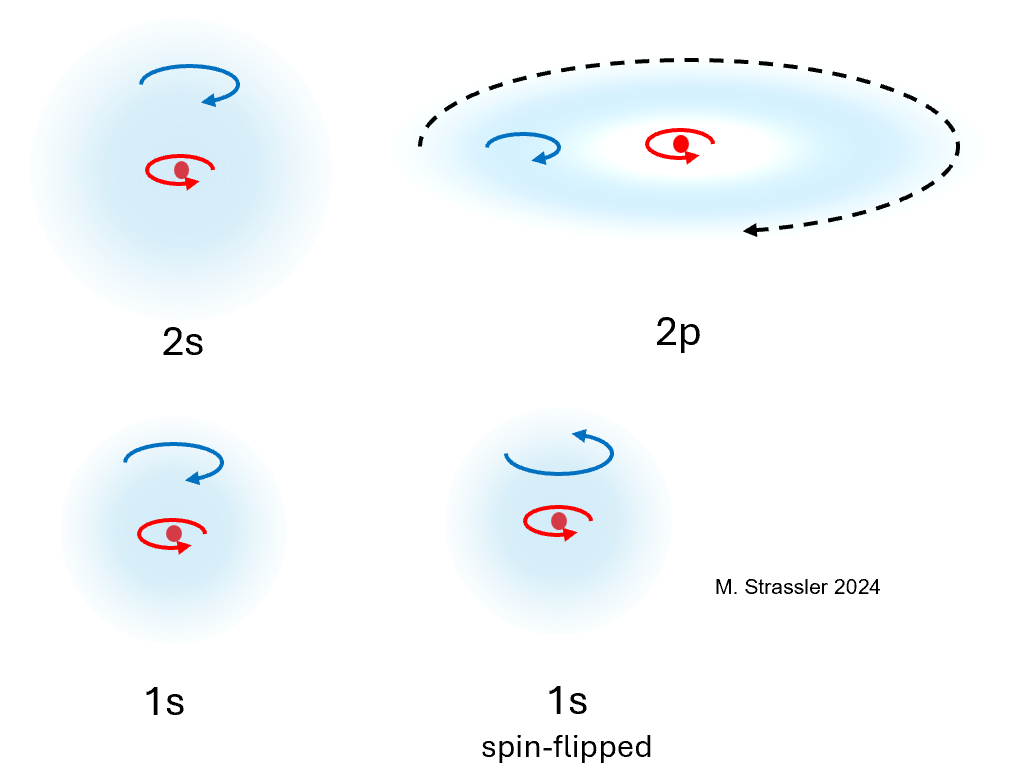
I’ll refer in the following to four atomic states, illustrated below in Fig. 2.
The ground state of a hydrogen atom (known as the “1s state”) has spin 0. Nevertheless, it is made of an electron with spin 1/2 surrounding a proton of spin 1/2. The two spin in opposite directions so that their angular momentum cancels.
There is a very slightly excited state, often neglected in first-year physics courses or in quick summaries of atomic physics, where the electron and proton spin in the same direction, and their spins add instead of cancelling. This state of the atom has spin 1; I’ll call it the “spin-flipped 1s state”. (The transition from this excited state to the ground state involves the emission of a radio wave photon with a wavelength of 21 cm, leading to the so-called “21 cm line” widely observed in astronomy. )
There are more dramatically excited states known as the “2s and 2p states”. The 2s state has spin 0, while the 2p state has spin 1. But even though the 2p state and the spin-flipped state both have spin 1, their spins have different origins. The total angular momentum of the 2p state does not come from the intrinsic angular momenta of the electron and proton; those cancel out, just as they do in the 1s and 2s states. Instead, the spin of the 2p state comes from a sort of rotational motion of the electron around the proton.
These four states are sketched in Figure 2. (Spin-flipped versions of the 2s and 2p states exist but are not shown.)
Figure 2: (Bottom left) In the ground state of hydrogen, the spin of the proton (central red dot) is opposite to that of the electron (surrounding blue cloud), so that the atom has spin 0. (Bottom right) If the electron spin is flipped, both the proton and electron spin in the same sense, giving the atom spin 1. (Top) While the 2s state is similar to the 1s state, the 2p state has the electron and proton spinning in opposite directions but has the electron moving around the proton (dashed black line), giving the atom spin 1.
The fact that the ground state has spin 0, and yet the 2p state has larger spin specifically due to the electron’s motion around the proton, illustrates the main point of this post. If an object is made from multiple constituent objects, nothing can prevent those constituents from moving around one another. That means they can have ordinary (or “orbital”) angular momentum, which then contributes, along with the constituents’ spin, to the combined object’s spin — i.e., to its total angular momentum.
Therefore, an object that is not elementary, and so contains multiple objects inside it, will inevitably have excited states with different amounts of spin. Indeed, the hydrogen atom has excited states of total angular momentum 0, 1, 2, 3, and so on. All atoms exhibit similar behavior.
The same applies for protons, which aren’t elementary either. The proton has spin 1/2, but its excited states have spin 1/2, 3/2, 5/2, 7/2, and so on. The first excited state of the proton, the Delta, has spin 3/2. This is most easily understood as a rearrangement of the spins of the quarks, gluons and anti-quarks that it contains (though the exact rearrangement is not obvious, due to the complexity of a proton; see also chapter 6 of the book.) The next excited state, the p(1440), has spin 1/2 like the proton. But many other excited states have been observed, with spin 3/2, 5/2, 7/2, 9/2, and perhaps even 11/2.
A string, such as one finds in string theory, is another object with internal constituents, which one might call bits-of-string. A string can always be spun faster. That’s why, in the superstring theory that is sometimes touted as a potential “theory-of-everything” (or in less grandiose language, a complete theory of space, fields and particles), there are states of all possible spin — any integer times 1/2. Unfortunately, were this really the theory of our universe, the higher-spin states of the string would probably have far too much mass for us to make them in near-term experiments, putting this prediction of the theory out of reach for now.
But string theory isn’t just useful in this rarified context. It can also be used to describe the physics of “hadrons” — objects made from quarks and gluons, including protons. All indications from experiments and numerical calculations do indeed suggest that hadrons come in all possible spins; this includes the excited states of the proton already mentioned above. (That said, the higher the spin, the harder it is to make the states, making it more and more challenging to observe them.)
Spin and the Electron, Muon and Tau
None of this is true for electrons, muons or taus, all of which have spin 1/2. No electron-like particle with spin 3/2 has ever been observed.
This argues strongly against the electron, muon and tau all being made from the same object. Atoms, protons and strings all have excited states with the same spin as the ground state, but at roughly the same mass, they also have excited states with more spin. If the muon were an excited state of the electron, we would expect to see an object with spin 3/2 that has a mass comparable to the muon, and certainly below the mass of the tau. Such a state would easily have been observed decades ago, so it doesn’t exist.
Are there loopholes to this logic? Yes. It is possible, in special circumstances, for the excited states with higher spin to have much larger masses than the excited states which share the same spin as the ground state. This is a long story which I won’t try to tell here, but examples arises in the context of extra dimensions, and others in the related context of exotic theories of quark-like and gluon-like objects (with buzzwords such as “AdS/CFT” or “gauge/string duality”).
However, it’s hard to apply the loophole to the muon and tau. In such a scenario, the electron should have many more cousins than just two, and some of the others should have observed by now.
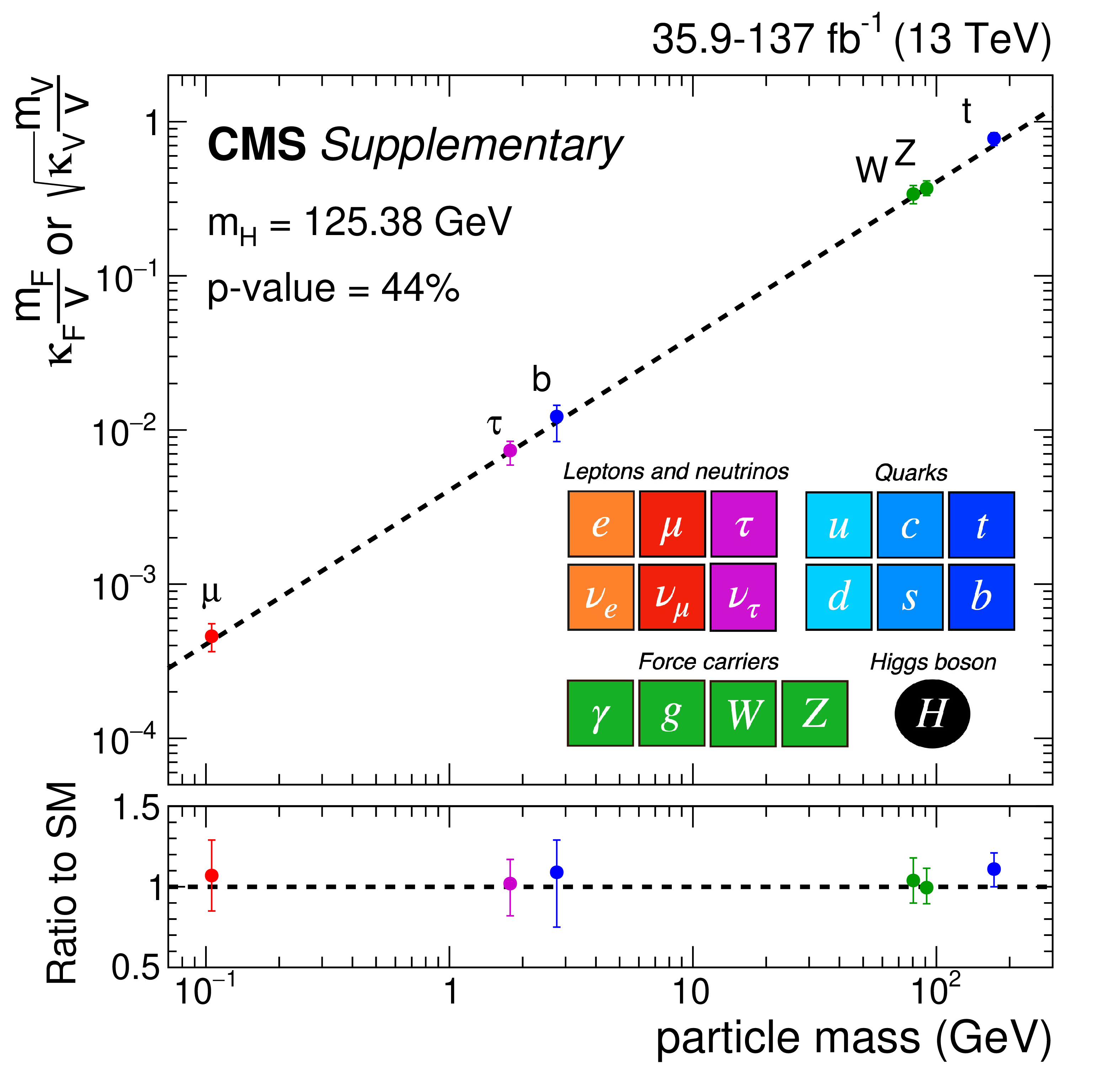
Furthermore, data now confirms that both the tau and muon get their rest mass from the Higgs field; see Fig. 3. For such particles, the loopholes I just mentioned don’t apply.
Figure 3: The interaction strengths of various types of elementary particles with the Higgs field, plotted versus those particles’ rest masses. Any particle whose rest mass comes entirely or largely from the Higgs field should lie on or near the dashed line. The data shows this is true of both the tau τ and the muon μ, as well as of the bottom and top quarks b, t, and of the W and Z bosons.
We must also recall the arguments given in the first part of this series. If muons and taus are excited states of electrons, it should be possible for any sufficiently energetic collision to turn an electron into a muon or tau, and for decays via photons to do the reverse. But these processes are not observed.
In short, the properties of the electron, muon and tau disfavor the idea that they are somehow secretly the same object in three different quantum states. The explanation of their similarities must lie elsewhere.
Tomorrow, Wednesday, May 15th, in the town of Northampton, Massachusetts, I’ll be speaking about my book — specifically, about why and how the relationship between ourselves and the universe is not what it seems. The event will be held at the Broadside Bookshop at 7pm. If you’re in the Pioneer Valley, please come by! And let your friends in the area know, too.
[UPDATE May 10, 4:00 pm Boston Time, 10:00 pm EU time: AURORAS MAY BE ACTIVE NOW!]
I don’t use exclamation marks in blog post titles lightly. For those of us hoping to see the northern and southern lights (auroras) outside their usual habitat near the Earth’s poles, this is one of those rare weekends where the odds are in our favor. NOAA’s Space Weather Prediction Center has issued a rare G4 forecast (out of a range from G1 to G5) for a major geomagnetic “storm”.
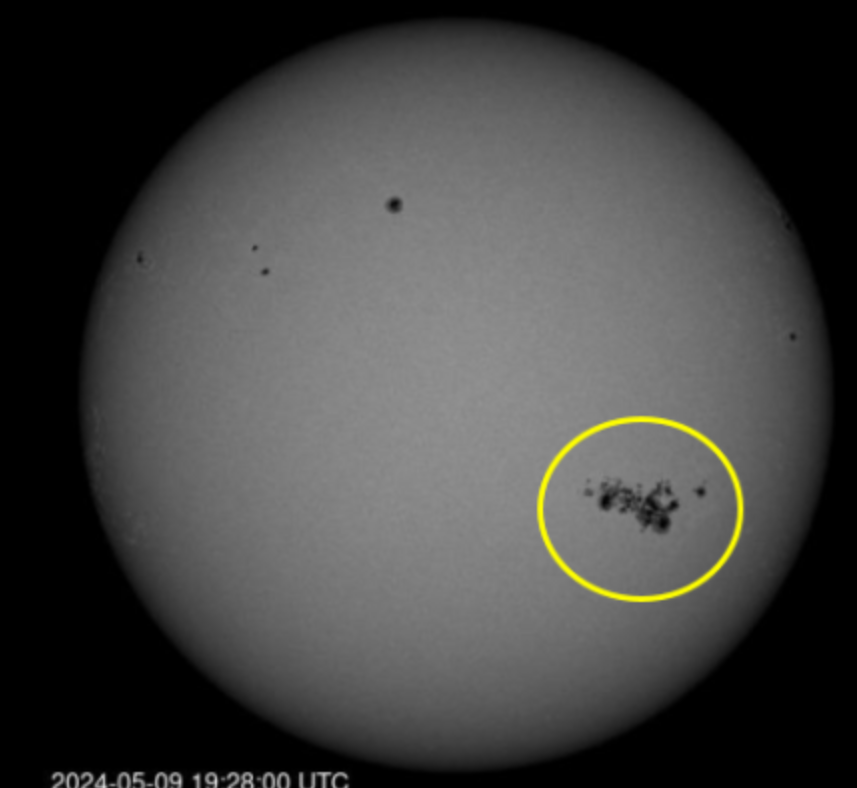
Though the large and active sunspot from earlier this week has moved on, it has been followed by an even larger group of sunspots, so enormous that you can easily see them with eclipse glasses if you’ve kept your pair from last month.
A monster sunspot group on the Sun right now (May 9, 2024).
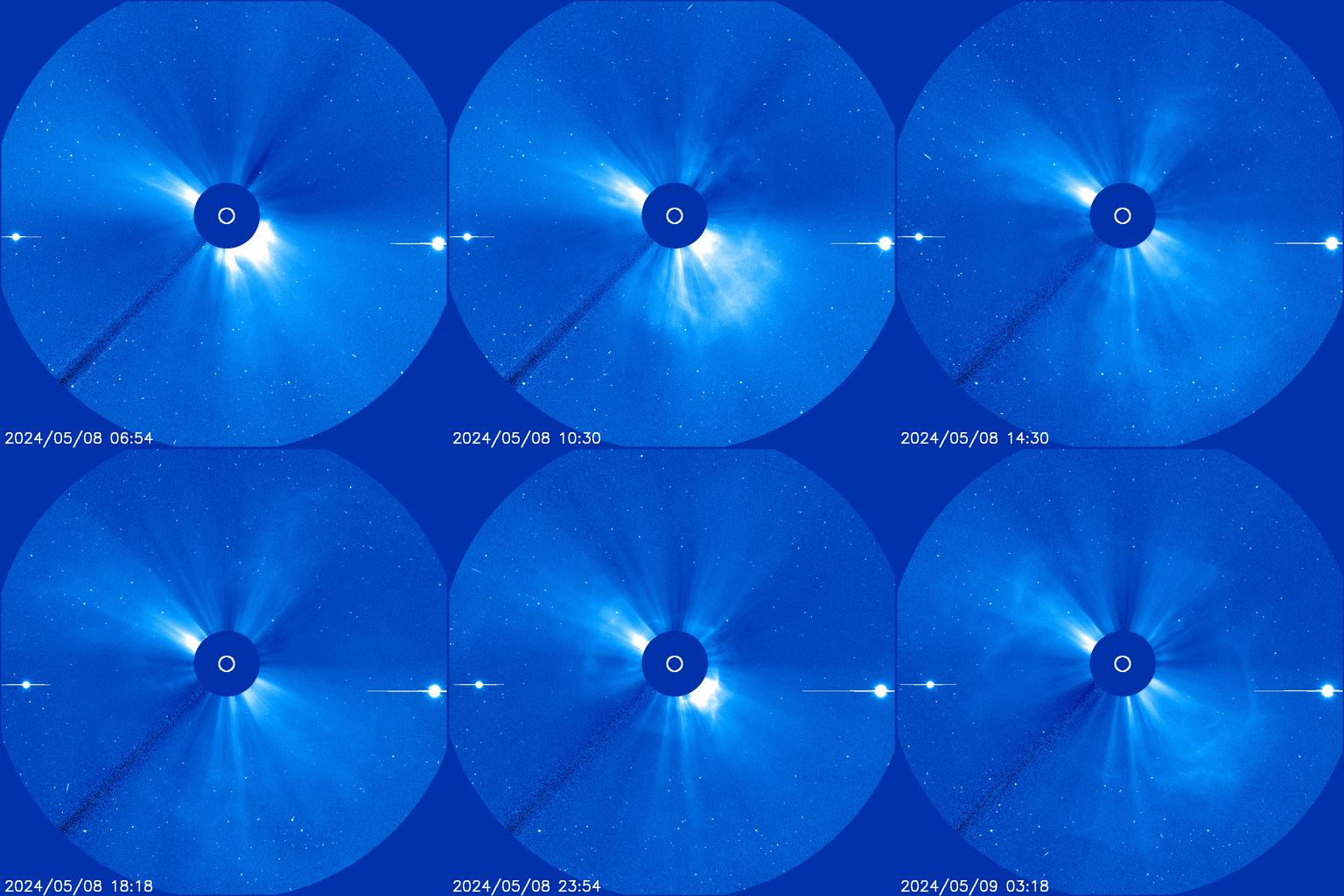
Powerful solar flares (explosions at the Sun’s visible surface) and the accompanying large coronal mass ejections (“CMEs”, huge clouds of subatomic particles that stream across space from the Sun toward the planets) keep coming, one after another; the second-largest of the week happened just a few hours ago. In the next 24-72 hours, the combined effects of these CMEs may drive the Earth’s magnetic field haywire, leading to northern and southern lights that are much stronger and much more equatorial than usual.
A couple of days ago, I noted a chance of auroras (a.k.a. northern and southern lights) this week. That chance just went up again, with a series of solar flares and coronal mass ejections. The chance of auroras being visible well away from their usual latitudes is pretty high in the 36-48 hour range… meaning the evening of May 10th into the morning of May 11th in both Europe (with the best chances) and in the US and Canada.
Keep in mind that timing and aurora strength are hard to predict, so no prediction is guaranteed; it could come to nothing, or the auroras could show up somewhat earlier and be stronger than expected.
Meanwhile, the SciComm 2 conference continues at the Perimeter Institute. As part of it, experimental particle physicist Clara Nellist gave a public talk to an enthusiastic audience last night, reviewing the LHC experiments and their achievements. You can find it on YouTube if you’d like to watch it.
Next week I’ll be back in Massachusetts, in the town of Northampton, where I’ll be speaking about my book. The event is at 7pm on Wednesday, May 15th at the lovely Broadside Bookshop. If you’re in the Pioneer Valley, please join me! And if you have friends in the area, please let them know.