Imagine a tunnel, circular in shape and 17 miles long. Its interior is 20 feet across (see the picture above). It is deep underground — as deep as 300 feet. In this tunnel lives the largest particle accelerator ever built.
When the machine is running, the accelerated particles — usually these will be protons (the particles which combine with neutrons to make up the nuclei of atoms) — will go round and round in the tunnel, some clockwise, some counterclockwise. They will travel in packs, or “bunches”, with about 100,000,000,000 protons in each bunch. The protons will travel at a speed that is just a tiny bit below the speed of light, circling the tunnel about 10,000 times a second.
At specified locations the two beams of bunches of protons will be aimed straight at each other. There, up to 40,000,000 times a second, a bunch heading clockwise will pass through a bunch heading counterclockwise — 100,000,000,000 protons heading to the right meeting 100,000,000,000 protons heading to the left — and everything will be arranged by the machine’s operators so that there will be a high probability that a few collisions of two protons, one from each bunch, will occur every time…
The energy of each collision will be more than 14000 times the energy that one would need to create a proton from scratch (using E = m c-squared). That’s 7 times more per collision than the collisions currently obtained at the Fermilab accelerator near Chicago. (As of 2011, the machine is operating with 1/2 the maximum energy — still plenty for discoveries!)
The protons are not free to move about the tunnel; they are carefully contained within a tiny pipe (actually two pipes, one for each beam, that cross and join at the “special locations” mentioned above). Each pipe is a few centimeters across and 17 miles around. It has to be maintained at a fantastically good vacuum — we don’t want those protons running into stray gas molecules and falling out of step with their friends, thereby disrupting the carefully organized beam.
A particle will move in a straight line unless acted on by a force; and protons are no exceptions. To keep them moving in a circle instead, inside the beampipe where they belong, requires extremely powerful magnets… a chain of them, thousands of them, as much as 30 feet long, surrounding the beam pipes and extending throughout the tunnel, one after another after another…
These are no ordinary magnets. To get them to be so powerful, they must be superconducting — unlike ordinary wires, which get hot when power flows through them (think about all the heat your computer generates,) superconductors, which only work at low temperatures, stay cool. They are therefore extraordinarily efficient. But to get the superconductivity, and the strong magnetic fields needed to operate the LHC, requires that these magnets be colder than outer space! They must be maintained at 1.9 degrees above absolute zero. (Outer space is at 2.7 degrees.) To do this requires a refrigeration system, which surrounds the magnets with liquid helium. This refrigeration system is by far the largest of its type ever built.
For a cross-section through the LHC, see http://www.computerweekly.com/galleries/235347-2/CERN-LHC-bending-magnets.htm , which shows the two beampipes side by side, surrounded by a magnet, which is housed inside the refrigeration system. (The beampipes are each a couple of inches — several centimeters — across.)
These are the main ingredients for the accelerator. Particles to accelerate. A pipe to hold them. Magnets to steer them. A refrigeration system to keep the magnets extremely cold, and therefore very powerful. There’s more (I haven’t told you how the particles are brought up to speed) but during normal operation, these are the key elements of the machine.
But that’s the accelerator itself. The science is actually done by studying the collisions that occur at those specialized locations I mentioned. Other, separate machines, called “detectors”, the size of a small office building, have been built around each of these locations, to allow the debris from the collisions to be observed, studied and interpreted. These detectors are a story unto themselves… to be told later…
For a schematic showing (not at all to scale) how the LHC is laid out, with two beam pipes (one in red, one in blue) crossing at four points, see the picture below. 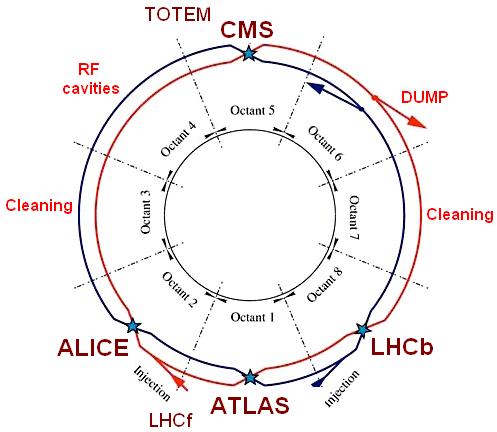
April 2, 2009


24 Responses
That was a very enlightening post. I happened to be shooting (well trying to anyway) a scorpionfly today in western Massachusetts. They are on the “hard time” list as far as my photography goes.fethiye rodos feribot
Can you please tell us why this guiding tubes for the protons are so Big? Wouldn’t it be easier to maintain a Building Wraps vacuum in a microscopic tube? The protons would surely all fit?
What a great idea of online music learning.
site
The protons are not free to move about the tunnel; they are carefully contained within a tiny pipe (actually two pipes, one for each beam, that cross and join at the “special locations” mentioned above).Furthermorejoint supplement
These are the main ingredients for the accelerator. Particles to accelerate. A pipe to hold them. Magnets to steer them. ourworld gem codes 2015
Hello,
How are you and A year later we’re still talking about the baest way to do it, and paying attention to what people do without it. We’re still patiently explaining to people why connecting Maths Tutoring Sydney with people in federated wiki is hard compared to other platforms, at least for the moment. We’ve focussed on other community solutions, like shareable “rosters” and customizable activity feeds
It’s hard just to say a few words. In a few words, it involves clever tricks with electric and magnetic fields, but that’s not so informative. To do a decent job, I need to write an article like this one, and before that I have a *lot* of work to do to review it carefully (since there are a lot of details that I will surely get wrong if I don’t.) Sadly, many articles for the public on the subject contain scientific flaws, and I haven’t found one yet that I can recommend to you… will keep looking.
Good day
why they call it Hadron collider and not Proton collider.
Because one month a year they collide entire atomic nuclei with one another. I haven’t written much about this “heavy ion” program, I’m afraid.
The protons are not free to move about the tunnel; they are carefully contained within a tiny pipe (actually two pipes, one for each beam, that cross and join at the “special locations” mentioned above).Howes himself may have different views when trade unions engage in unlawful industrial action eyeglasses portland
How protons are ‘poured’ into the tubes to be accelerated later on? Sorry for I’m just a lay man. Thanks
Can you actually see with the human eye the collisions? do they release energy you can see? Are the protons so small they would go through your hand? I am looking everywhere for this info of what would happen if they hit you or can you see them colliding?
Yes, the vast majority of the protons would go right through the enormous gaps between the atomic nuclei that make up your hand; a small fraction (but still a large number, because the beams have so many protons) would hit something in your hand, do severe damage to your biological molecules, and heat your hand up, eventually burning a tiny hole in it.
In any case you couldn’t do this; unless the beams are in a metal tube from which all air has been evacuated, the protons will hit air molecules and the beams will degrade in very brief period (I’m not sure how long it would take without calculating it, but probably less than a second.) So you can’t put your hand in front of the beam without smashing it through the metal tube.
No, the collisions are each so tiny and intense that any light emitted in the collision would be in the form of gamma rays, completely invisible to the naked eye (our eyes see only a very narrow range of light), but also damaging to your eye’s lens and your body more generally.
Humans are not allowed in the tunnel while the collisions are going on. The hundred meters of earth that are above the tunnel make the collisions perfectly safe if you are above ground, but you do not want to be inside the tunnel with high-energy particles being scattered around.
Two particles will collide in the center, but at what actual velocity or speed taking relativity etc into consideration
0.999 + 0.999 = ?
or
Approx 0.999 ?
Please help me understand?
Thanks Alan
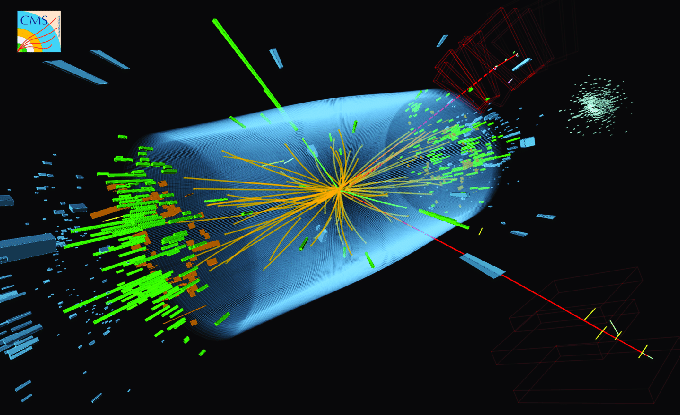
I’ve found some beautiful “images” of particle collisions but what do they actually look like? I’ve been trying to find out but with no luck, just more amazing pictures! Is the reality that the scientists are looking at pure data (0’s and 1’s in reams of printouts) or graphs? Apologies for not being very technical, I’m a fascinated novice!! Thank you!
Oh, okay. I understood.
(As of 2011, the machine is operating with 1/2 the maximum energy — still plenty for discoveries!)
is it half the energy or half the power?
Half the energy per collision. Not half the power. The power involves the energy per collision times the number of collisions per second; in 2011 the power was a lot less than half the maximum. They’re getting close to half power now, but that actually isn’t so important. It is energy per collision and number of collisions per second that really are the key quantities to follow separately, because they determine what you can scientifically: energy per collision sets the maximum mass of any new particle you can create, and number of collisions per second sets the number of the particles that you can make. If you made the collision rate 100 times larger but lowered the energy per collision by a factor of 100, you’d use the same power but wouldn’t ever make a single Higgs particle. Thanks for the question.
Can you tell us why the guiding tubes for the protons are so large? Wouldn’t it be easier to maintain a vacuum in a microscopic tube? The protons would surely all fit?
The tubes (“beampipe”) don’t guide the protons; they just keep air away from the protons. Inside the beampipe all the air has been removed, so that the protons aren’t constantly running into air molecules.
The protons are actually guided by electric and magnetic fields, which have to keep the protons away from the sides of the beampipe. The limitations on the accelerator operators’ ability to control the proton beam using electric and magnetic fields is what forces the beampipe to be a certain size: if the beam hits the wall of the beampipe, it will cause damage to the pipe and surrounding equipment, so the distance across the beampipe had better not be too small.
That said, we want the beampipe as small as possible in the regions where proton-proton collisions occur (four points around the tunnel). We want to measure all the particles that come flying out of the collision as precisely as possible, but all devices used to do this have to be outside the beampipe (with a couple of interesting exceptions, but that’s a long story.) Also, away from the collision points the beampipes can’t be too big because they have to be surrounded by the giant magnets used to bend the beam so that it travels in a (rough) circle.
It is the balance of these various considerations that determine how big the beampipe has to be in the locations near the collision points and elsewhere. Near the collision points the radius of the tube is a couple of centimeters.
I’ve been reading about particle accelerators/physics for quite a while now, but your explanations are among the most lucid and tantalizing I’ve ever seen. Keep up the good work!
Thanks for this description! Could you please say a few words about how the accelerator actually accelerates the protons?
It’s hard just to say a few words. In a few words, it involves clever tricks with electric and magnetic fields, but that’s not so informative. To do a decent job, I need to write an article like this one, and before that I have a *lot* of work to do to review it carefully (since there are a lot of details that I will surely get wrong if I don’t.) Sadly, many articles for the public on the subject contain scientific flaws, and I haven’t found one yet that I can recommend to you… will keep looking.
Do you think there’s a chance that the Tevatron will postpone shutting down in order to help evaluate/duplicate the recent discovery of possibly faster-than-light neutrinos clocked at CERN? Is the Tevatron powerful enough to help, if it could remain open?