Tag Archives: press

Not As Painless As They’d Have You Believe

I’m still seeing articles in the news media (here’s one) that say that the majority of Americans think the recent sequester in the US federal budget isn’t affecting them. These articles implicitly suggest that maybe the sequester’s across-the-board cuts aren’t really doing any serious damage.

Well, talk to scientists, and to research universities and government laboratories, if you want to hear about damage.

I haven’t yet got the stomach to write about the gut-wrenching destruction I’m hearing about across my own field of particle physics — essential grants being cut by a quarter, a third, or altogether; researchers being forced to lay off long-standing scientific staff whose expertise, of international importance, is irreplaceable; the very best postdoctoral researchers considering leaving the field because hard-hit universities across the country won’t be hiring many faculty anytime soon… There’s so much happening simultaneously that I’m not sure how I can get my head around it all, much less convey it to you.

But meanwhile, I would like to point you to a strong and strongly-worded article by Eric Klemetti, a well-known blogger and professor who writes at WIRED about volcanoes.  Please read what he wrote, and consider passing it on to those you know.  Everyone needs to understand that the damage that’s being done now across the U.S. scientific landscape, following a period of neglect that extends back many years before the recession, will last a generation or more, if it’s not addressed.

These deep, broad and sudden cuts are a short-sighted way of saving money.  Not only do they waste a lot of money already spent, the long-term cost of the permanent loss of expertise, and of future science and technology, is likely to exceed what we’ll save.  It’s not a good approach to reducing a budget.  So tell your representatives in Congress, and anyone who will listen: Scientific research isn’t excess fat to be chopped off crudely with a cleaver; it’s fuel for the nation’s future, and it needs wiser management than it’s receiving.

Cosmic Conflation: The Higgs, The Inflaton, and Spin

Over the past week or so, there has been unnecessary confusion created about whether or not there’s some relationship between (a) the Higgs particle, recently discovered at the Large Hadron Collider, and (b) the Big Bang, perhaps specifically having to do with the period of “Cosmic Inflation” which is believed by many scientists to explain why the universe is so uniform, relatively speaking. This blurring of the lines between logically separate subjects — let’s call it “Cosmic Conflation” — makes it harder for the public to understand the science, and I don’t think it serves society well.

For the current round of confusion, we may thank professor Michio Kaku, and before him professor Leon Lederman (who may or may not have invented the term “God Particle” but blames it on his publisher), helpfully carried into the wider world by various reporters, as Sean Carroll observed here.

[Aside: in this post I'll be writing about the Higgs field and the Higgs particle. To learn about the relationship between the field and the particle, you can click here, here, here, or here (listed from shortest to most detailed).]

Let’s start with the bottom line. At the present time, there is no established connection, direct or indirect, between (a) the Higgs field and its particle, on the one hand, and (b) cosmic inflation and the Big Bang on the other hand. Period. Any such connection is highly speculative — not crazy to think about, but without current support from data. Yes, the Higgs field, responsible for the mass of many elementary particles, and without which you and I wouldn’t be here, is a spin-zero field (which means the Higgs particle has zero spin). And yes, the “inflaton field” (the name given to the hypothetical field that, by giving the universe a lot of extra “dark energy” in the early universe, is supposed to have caused the universe to expand at a spectacular rate) is also probably a spin-zero field (in which case the inflaton particle also has zero spin). Well, fish and whales both have tails, and both swim in the sea; yet that doesn’t make them closely related. Continue reading

Why the Higgs Matters, In A Few Sentences

One of the big challenges facing journalists writing about science is to summarize a scientific subject accurately, clearly and succinctly. Sometimes one of the three requirements is sacrificed, and sadly, it is often the first one.

So here is my latest (but surely not last) attempt at an accurate, succinct, and maybe even clear summary of why the Higgs business matters so much.

`True’ Statements about the Higgs

True means “as true as anything compressed into four sentences can possibly be” — i.e., very close to true.  For those who want to know where I’m cutting important corners, a list of caveats will follow at the end of the article.

  • Our very existence depends upon the Higgs field, which pervades the universe and gives elementary particles, including electrons, their masses.  Without mass, electrons could not form atoms, the building blocks of our bodies and of all ordinary matter.
  • Last July’s discovery of the Higgs particle is exciting because it confirms that the Higgs field really exists.  Scientists hope to learn much more about this still-mysterious field through further study of the Higgs particle.

Is that so bad? These lines are almost 100% accurate… I’m sure an experienced journalist can cut and adjust and amend them to make them sound better and more exciting, but are they really too long and unclear to be useable?

Some False Statements about the Higgs Continue reading

Can You Find The Higgs-Like Particle?

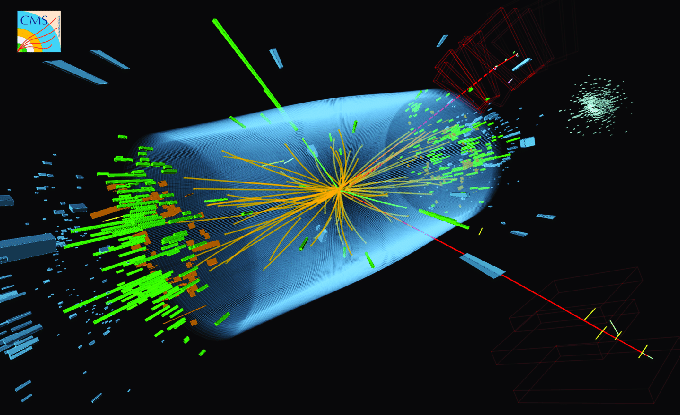
Ok, everyone; by now you’ve all learned that the ATLAS experiment at the Large Hadron Collider [LHC] announced recently their measurement of the mass of the Higgs particle, in its decay to two photons, is at 126.6±0.3±0.7 GeV/c²; and meanwhile they measure the mass for apparently the same particle, in its decay to two lepton/anti-lepton pairs, to be 123.5±0.9+0.4-0.2 GeV/c², about 3 GeV/c² lower. “So bizarre”, wrote Michael Moyer at Scientific American,  bandying about the idea that there are two Higgs-like bosons in this data (though, having pointed out the ambulance to you, and neglecting also to mention CMS’s data from November that directly disfavors this interpretation of the ATLAS data, he tells you later that some physics bloggers say you shouldn’t chase it…)

Well.  How bizarre is this 2.7  standard deviation discrepancy really?

At the end of this post are 20 plots showing randomly generated data, in amounts comparable to those used in the current measurement of Higgs decaying to two lepton/anti-lepton pairs (often called “four leptons” for short). [Warning: This certainly hasn't been done with the level of care needed to match the ATLAS measurement in any precise way; I'll say a bit more below about the caveats.]

  • In some of the plots, there’s just a random flat background of about 40 events, similar (though not identical) to what arises in the four-lepton Higgs measurement.
  • In some of the plots, there’s a Higgs-like peak of about 20 events — a very sharp peak with a perfect detector, but one which is smoothed out a bit by the inevitable imperfections in a real particle detector.
  • In each plot with a peak, the mass of the Higgs has been chosen to lie somewhere between 122 GeV/c² and 127 GeV/c² [not equally populated].

So:

  1. Can you tell which plots have a Higgs-like signal, and which ones don’t?
  2. In each plot where there is a signal, can you estimate the Higgs mass? Again, in each plot, it lies somewhere between 122 and 127 GeV/c².  You’re not going to get it exactly right — that’s impossible — but do your best, and let’s see what happens.

A couple of additional comments to help you:

  • The resolution on the measurement (i.e., the effect of imperfections in the measurement) is such that with infinite amounts of data, the peak that you’d observe would be a bump whose width, at half the bump’s maximum height, would be about 4 GeV/c².
  • The bins in each plot are 1 GeV/c² wide; the bin just to the right of the number 2 in “125” runs from 125 to 126, the next from 126 to 127, and so forth.

Lastly, a caveat: in the real ATLAS or CMS measurement, the mass of the Higgs is not measured simply by fitting a Gaussian peak over a flat background. So don’t take this exercise too seriously! It’s just a useful learning experience, and nothing more.  What the experiments  actually do is far more sophisticated, accounting for the properties of each event separately!!

Here we go: Good Hunting!  (If your browser has trouble with the figure, try clicking on it.)

[Solution is now available.]

Twenty sets of simulated data, showing number of events versus the “mass” of a putative particle, in GeV/c2. Each contains about 40 events of a non-Higgs-like background that is flat in mass.  Some but not all plots contain a signal which is in the form of a peak, comparable to the current size of the expected Higgs particle signal (about 20 events). In each case the mass of the Higgs is chosen between 122 and 127 GeV/c2.  Experimental imperfections make the full-width of the signal peak at half its maximum about 4 GeV/c2 wide.

My Version of the TIME Higgs Paragraph

A few commenters have complained that I’m too hard on science journalists, who have a tough job; it’s hard to explain difficult concepts in a few words.  To paraphrase them: “if it’s so easy, you do it!  Rather than merely complain about the erroneous TIME magazine paragraph on the Higgs boson, write your own explanation of the Higgs particle for readers of TIME magazine.”

Well, first of all, I have never once suggested science journalism is easy; far from it!  A big part of the challenge is to find ways to explain complex ideas that are simple, compelling and accurate (and not two out of three.)

Second, I have written an article suitable for non-expert readers; it’s just over a page long, and is called Why the Higgs Particle Matters.  It’s gotten about 30,000 hits; some people seem to really like it, so try it out on your friends.

And third, for those who point out that the above-mentioned article is much longer than a paragraph, and that I shouldn’t be so critical of the TIME journalist who had to fit so much into a such a small space, here is my version of the TIME paragraph: six sentences rather than five, but scarcely longer.  I have borrowed the style and the feel of the TIME journalist’s writing, and I have removed some inaccurate content and replaced it with different accurate content.

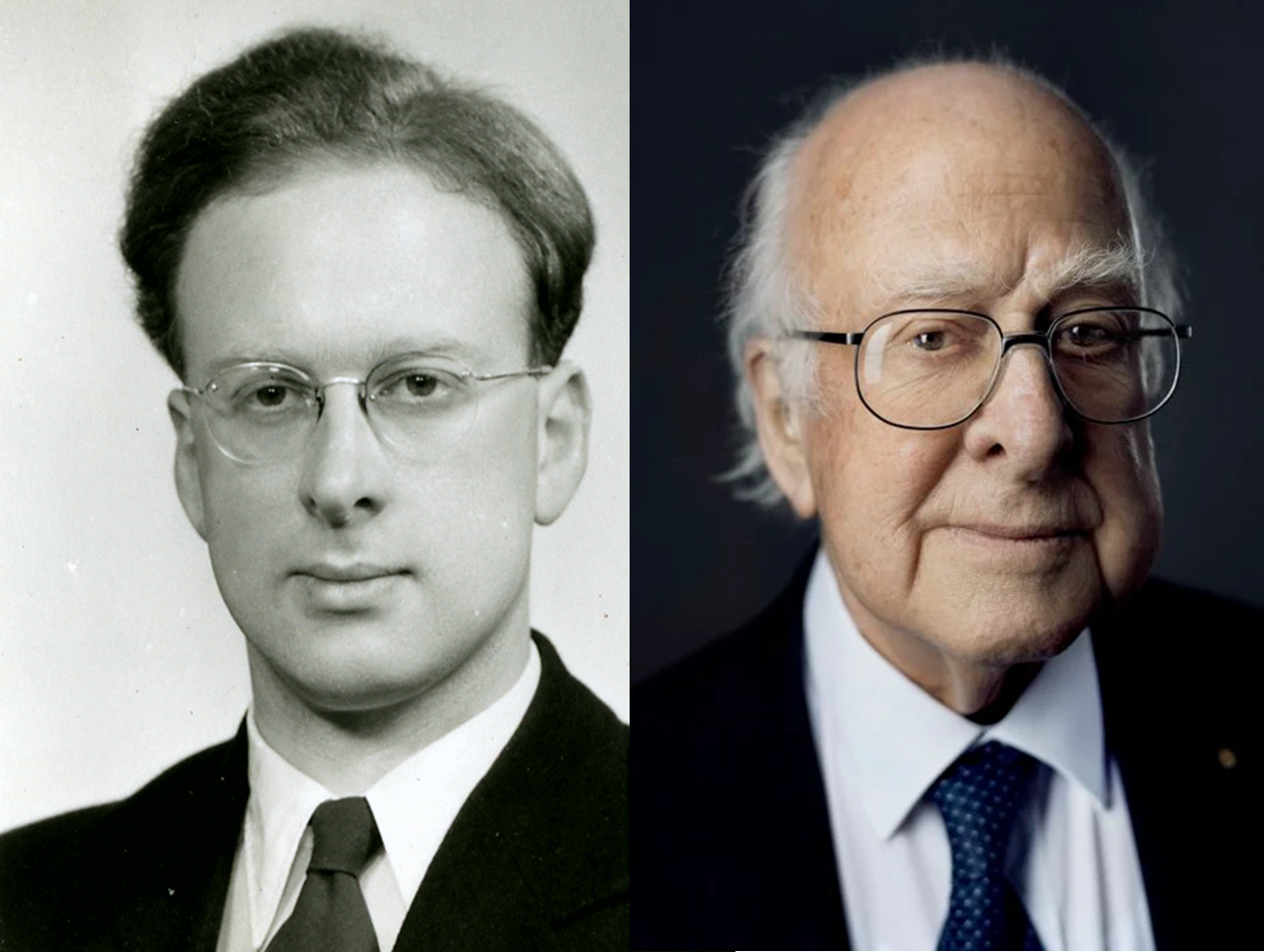
  • Take a moment to thank the Higgs field for all the work it does, because without it, you’d explode.  This field pervades the universe and supplies electrons (and many other particles) with their mass, thus preventing ordinary matter from disintegrating into a ghastly vapor.   It was in the 1960s that British physicist Peter Higgs (and a few others) first posited the existence of this field.  But it was not until last summer that two huge teams of researchers at Europe’s Large Hadron Collider at last sealed the deal by discovering a new particle — the Higgs boson — which confirms the Higgs field exists.  You see, the particle is a consequence of the field wiggling a bit; and just as sound, a ripple in the air, can’t be heard unless there’s air in the room, there wouldn’t be Higgs particles to discover unless Higgs and friends were right all along about their famous field.  Now the Higgs — as most particles do — decays in an instant to other particles, so it wouldn’t be able to attend the award ceremony; however, the scientists would surely be happy to appear in its stead.

Although not everything I’ve written here is 100% accurate — that would indeed be impossible in a paragraph for a wide readership — I believe none of it is fundamentally wrong (but my colleagues should feel free to complain!)  Yes, science journalism is difficult; but is it really inevitable that profound errors concerning the science must appear in articles for the public?

TIME for a Little Soul-Searching

Yes, it was funny, as I hope you enjoyed in my post from Saturday; but really, when we step back and look at it, something is dreadfully wrong and quite sad.  Somehow TIME magazine, fairly reputable on the whole, in the process of reporting the nomination of a particle (the Higgs Boson; here’s my FAQ about it and here’s my layperson’s explanation of why it is important) as a Person (?) of the Year, explained the nature of this particle with a disastrous paragraph of five astoundingly erroneous sentences.   Treating this as a “teaching moment” (yes, always the professor — can’t help myself) I want to go through those sentences carefully and fix them, not to string up or further embarrass the journalist but to be useful to my readers.  So that’s coming in a moment.

But first, a lament.

Who’s at fault here, and how did this happen?  There’s plenty of blame to go around; some lies with the journalist, who would have been wise to run his prose past a science journalist buddy; some lies with the editors, who didn’t do basic fact checking, even of the non-science issues; some lies with a public that (broadly) doesn’t generally care enough about science for editors to make it a priority to have accurate reporting on the subject.  But there’s a history here.  How did it happen that we ended up a technological society, relying heavily on the discoveries of modern physics and other sciences over the last century, and yet we have a public that is at once confused by, suspicious of, bored by, and unfamiliar with science?   I think a lot of the blame also lies with scientists, who collectively over generations have failed to communicate both what we do and why it’s important — and why it’s important for journalists not to misrepresent it. Continue reading